01 — THE NEED THE SYSTEM SERVES
Some journeys are not departures. A person stays away from one of their usual environments for a period of time — to work, to think, to recover, to be near family, to complete a project, or simply because their life now unfolds across more than one place. They do not want to interrupt their life while they are there. They want to keep living it.
Conventional hospitality is generally organised around arrival, temporary occupation and departure. This structure serves many forms of travel effectively, but it does not always allow everyday life to continue naturally when a person requires greater autonomy, privacy and continuity. The occupant remains within the rhythm of the property rather than being free to preserve their own.
AERA exists to serve this condition. It is the Governed Hospitality System of Continuity — the ability to continue living, working, resting and keeping one's ordinary habits while staying somewhere else.
The need is not a market segment and not a demographic. It is a situation people find themselves in, and it recurs — which is why the same person tends to return.
02 — THE HOSPITALITY CONCEPT
Continuity translated into hospitality produces a specific form: private, domestic, autonomous, calm and genuinely habitable.
Each occupant has a fully domestic hospitality unit rather than a conventional hotel room. It has a real kitchen, so meals are a matter of choice rather than of opening hours. It has somewhere proper to work, with the surface, light and quiet that sustained work requires. It has storage for the belongings everyday life requires, and private exterior space belonging exclusively to that unit. Nothing about the day needs to be negotiated with the property.
Hospitality remains present, but it sits behind the life rather than in front of it. Service is available and reliable; it is not staged, and it does not announce itself. There is no programme to join, no calendar to keep up with, no social structure the occupant is expected to enter. The rhythm of the stay belongs to the person staying.
The concept can be stated in one line: the autonomy of private living, held together by the coherence and reliability of hospitality.
03 — THE ASSET AND ITS PREFERRED TERRITORIAL CONTEXT
AERA is one Governed Hospitality System expressed through two official physical configurations. Both are organised around Continuity, domestic autonomy, private exterior space, discreet service and a calm relationship with an active anchor. They differ in scale, density, capital intensity and accommodation form — not in doctrine.
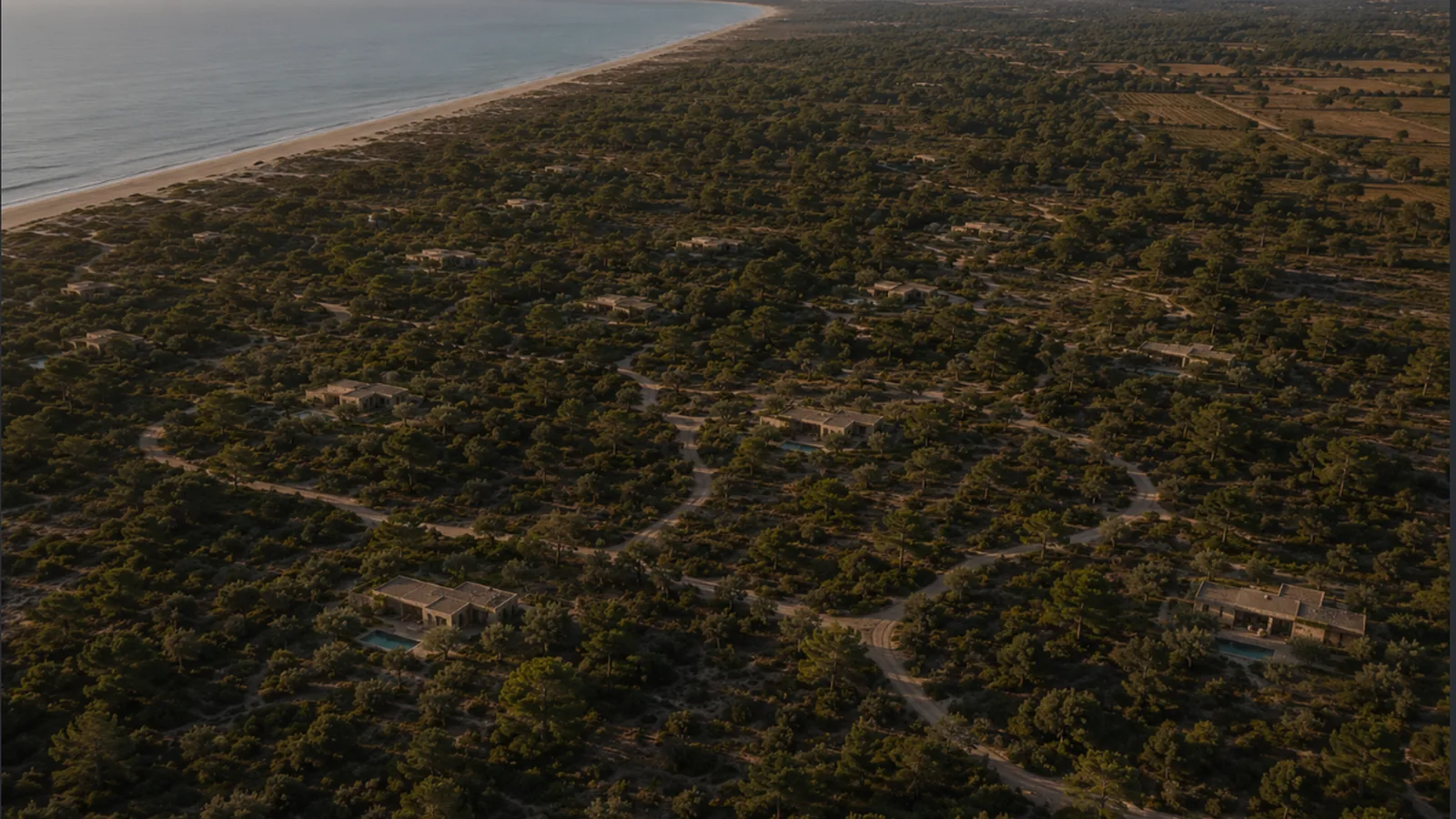
- AERA Premium Villas: detached, low-density villas with substantial territorial separation.
- AERA Terraced Villas: compact single-level terraced villas with private lots and their own exterior space.
- Both configurations provide complete kitchens and full domestic self-sufficiency.
- Both provide dedicated working, living and rest conditions for extended inhabitation.
- Private exterior territory belongs to every hospitality unit; the degree of land separation differs by configuration.
- Shared and service infrastructure remains restrained and subordinate in both configurations.
The two configurations are intentionally distinct. AERA Premium Villas is the original detached-villa expression of the system. AERA Terraced Villas provides the same Condition of Life through a more compact physical and economic structure. They may be developed independently or on adjacent sites under the same ownership, but adjacency does not create a hybrid typology: each configuration retains its own corpus, dimensions, density logic and financial model.
| Configuration | Official territorial and physical position |
|---|---|
| AERA Premium Villas | Type A — Peri-Urban Edge, Type B — Coastal Transition and Type C — Quiet Inland. Detached villas, very low density and substantial landscape separation. |
| AERA Terraced Villas | Type A — Peri-Urban Edge and Type B — Coastal Transition only. Single-level terraced villas with 250 / 300 m² private lots. Gross site envelope: approximately 1.30–2.73 ha (Type A) and 0.975–1.95 ha (Type B), unit-mix dependent. |
| Common AERA condition | Calm Proximity, connection without urban intensity, domestic autonomy, privacy, recurrence and no resort-style programming. |
The physical references are configuration-specific. AERA Premium Villas retains the original territorial density ceilings: one accommodation unit per 4,000 m² in Type A, per 5,000 m² in Type B and per 7,000 m² in Type C. AERA Terraced Villas uses TV-T01 at 75–85 m² on a 250 m² private lot and TV-T02 at 110–120 m² on a 300 m² private lot, with an additional 30% common allowance for roads, access and circulation.
For AERA Premium Villas, the general reference remains approximately 20–50 hectares, with Type A capable of beginning from approximately 15 hectares where the complete configuration remains credible. AERA Terraced Villas is intentionally more compact. Under its official capacity ranges and fixed lot standards, the arithmetic gross site envelope is approximately 1.5 –3 hectares for Type A (40–70 terraced villas) and 1–2 hectares for Type B (30–50 terraced villas), depending on the TV-T01 / TV-T02 mix. The 42-unit reference mix corresponds to approximately 1.456 hectares gross site area.
These are not competing definitions of AERA. They are two controlled applications of the same system. Premium Villas protects Continuity through territorial distance and detached inhabitation; Terraced Villas protects it through compact private living, domestic completeness and disciplined separation from conventional residential or serviced-apartment logic.
04 — WHAT MAKES THE SYSTEM DIFFERENT
Several established categories touch parts of what AERA does. None of them is organised around Continuity, and neither AERA Premium Villas nor AERA Terraced Villas becomes equivalent to those adjacent categories simply because its physical form changes.
| Adjacent category | How AERA differs |
|---|---|
| Resort | A resort is designed to be experienced. Its value comes from what it offers and stages. AERA is designed to be inhabited: its value comes from what it allows the occupant to continue doing. |
| Serviced residence | A serviced residence supplies accommodation and service efficiently, usually in an urban setting. AERA adds territory, landscape, privacy and architectural coherence, and treats the hospitality unit as a complete environment rather than a serviced accommodation product. |
| Independent rental villa / residence | An independent rental unit can offer autonomy and privacy, but each property stands alone. AERA provides those qualities within a governed system — consistent inhabitation standards, dependable service, territorial logic and a coherent environment, whether expressed as Premium Villas or Terraced Villas. |
| Wellness hospitality | Wellness hospitality offers a programme intended to change something. AERA offers conditions intended to sustain something. Nothing is prescribed; the occupant arrives already knowing how they want to spend their time. |
| Activity-based community | A community property structures social life as its central proposition. AERA leaves social life to the occupant, and is designed for people who do not need it supplied. |
Stated positively: AERA is a hospitality system for private, autonomous inhabitation within calm, high-quality and connected territory. Premium Villas and Terraced Villas provide two distinct ways to deliver that same Continuity: the unit is complete, service is quiet, territory is respected and the days belong to the person staying.
05 — HOW THE SYSTEM OPERATES
The operating logic follows from the concept and stays deliberately simple.
- Service is discreet, reliable and responsive, and remains largely out of sight.
- Daily autonomy is the default: the occupant does not depend on the property to eat, work or organise the day.
- There is no imposed programming — no activity calendar and no expected participation.
- Friction is kept low across arrival, the stay itself and departure.
- The environment accommodates extended and recurring stays, with the duration of each stay determined by the continuity needs of the occupant.
An operator is appointed by the Project Owner and remains free to establish the commercial execution suited to the project and its market — including rate strategy, distribution, channel management, stay mix and demand management — within the selected AERA configuration's established positioning and operating logic.
06 — THE ECONOMIC LOGIC
Continuity is a Condition of Life. It can also support viable hospitality assets through more than one development equation. AERA Premium Villas and AERA Terraced Villas share domestic autonomy, operational restraint, recurrent use and extended occupation patterns, while carrying different land, CAPEX and pricing structures.
| Characteristic | Economic consequence |
|---|---|
| Lower turnover intensity where stays extend | Where occupation extends beyond conventional short-stay patterns, arrival, departure, preparation and booking-acquisition costs are distributed across a longer period of occupancy. |
| Domestic autonomy | Because the hospitality unit is complete, much of the daily rhythm is supplied by the occupant rather than by the property, and service can be reliable without being continuous. |
| Contained service structure | The operating organisation stays proportionate to what the concept actually requires, rather than to the standing infrastructure a conventional property carries. |
| No collective functions the concept does not need | Facilities that exist mainly because a category expects them are absent, and so are the operating layers that come with them. |
| Recurring demand | The need for Continuity can recur for the same person over time. Recurring occupancy can reduce dependence on continually acquiring new demand. |
| Two coherent development positions | Premium Villas supports a higher-rate, highly territorial position. Terraced Villas lowers land and development intensity and can support a more accessible rate while preserving the same Continuity logic. Each configuration is modelled independently. |
These characteristics describe why both configurations can work; they do not predetermine performance. Rate, occupancy, cost structure, capital requirement and return depend on the selected configuration, territory, site, market, construction environment, operator and moment. Each is established through its own complete financial model, and the economics of Premium Villas must not be blended with those of Terraced Villas.
07 — WHAT THE SYSTEM PROVIDES
AERA is not an idea awaiting development. It is a complete institutional hospitality system, developed before any individual project and made available for project-specific application through the applicable GHS Project Package and dedicated GovHos AI environment.
| Domain | What is already defined |
|---|---|
| Hospitality concept | The form of hospitality itself: what the environment is, how it is inhabited, and what it must protect. |
| Doctrine and identity | The founding doctrine of the system, its institutional principles and the identity standards through which it is expressed. |
| Territorial logic | How territory is read and assessed for AERA, including the different territorial eligibility and density / lot rules applicable to Premium Villas and Terraced Villas. |
| Typologies | Two official AERA configuration families are defined: AERA Premium Villas and AERA Terraced Villas. Each has its own unit typologies, dimensions, density / lot logic, territorial eligibility and financial model. |
| Architectural and interior principles | The design and material principles through which the system is translated into a specific place, climate and building culture. |
| Operational logic | The service model, the operating posture, and what the environment requires in order to function as intended. |
| Economic framework | The economic reasoning of the system and the separate modelling methods through which Premium Villas and Terraced Villas economics are established. |
| Operator compatibility | What an operator must be capable of, and how operator standards are integrated without redefining the asset. |
| Structural governance | How the system remains coherent over time, across owners, operators and successive project stages. |
| Implementation and continuity | The methods for applying and validating the system, and for preserving its coherence from project definition through opening and long-term asset evolution. |
The reader of this document is not being shown a concept to be developed. They are being shown one complete hospitality system with two distinct official configurations, each ready to be applied without hybridisation.