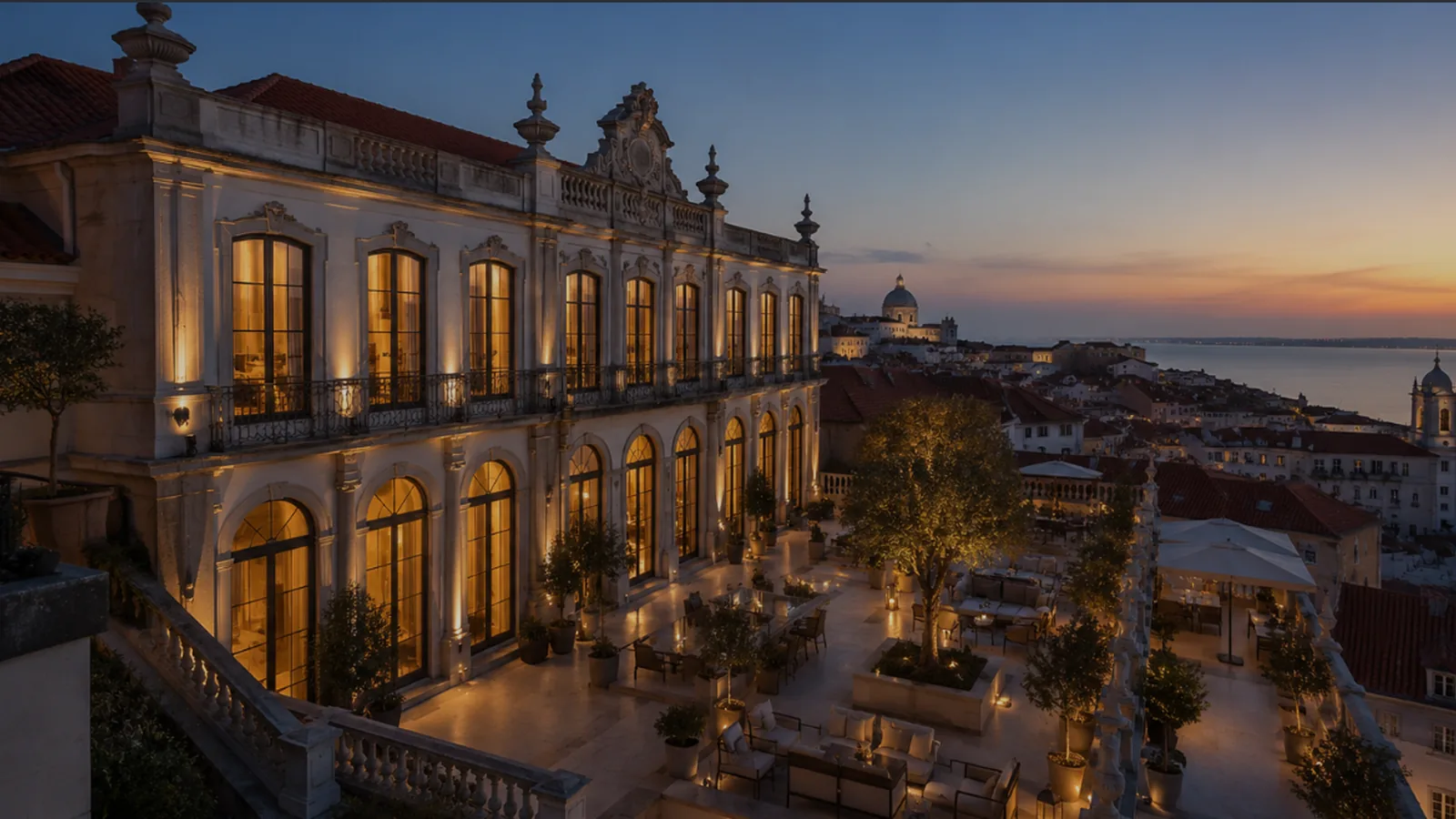
01 — THE NEED THE SYSTEM SERVES
Some historic buildings remain standing but disappear from the life that once gave them meaning. Others are converted into hotels so completely that their accumulated identity is replaced by a standard hospitality product. At the same time, a person may stay in the centre of a city while remaining separated from its architecture, daily rhythm and public life.
ATRIA exists where these two losses meet: the need to keep a significant urban building alive through contemporary use, and the need to inhabit a city without being enclosed inside a destination that competes with it.
ATRIA is the Governed Hospitality System of Presence — the continued inhabitation of one existing building within one living city, where architecture, memory and public life remain active rather than merely preserved.
The need is not nostalgia and not conservation for its own sake. It is the continuation of urban presence: the building remains active, the city remains primary and hospitality gives both a viable contemporary life.
02 — THE HOSPITALITY CONCEPT
Presence translated into hospitality produces a specific form: one significant existing urban building, adapted through contemporary hospitality while remaining embedded in the life of its city.
The building determines the project. Its rooms, courtyards, passages, stairs, proportions, materials, irregularities and accumulated layers shape the accommodation, public spaces and circulation. Contemporary intervention makes the building viable and hospitable without erasing what time has already made.
Hospitality supports inhabitation rather than replacing the city. Arrival unfolds through the existing building, service remains proportionate to its architecture, public rooms retain a meaningful relationship with urban life, and food or social spaces connect naturally to the city rather than turning the property into an inward-looking destination.
The concept can be stated in one line: one existing building remains alive through contemporary hospitality, while the city remains primary.
03 — THE ASSET AND ITS PREFERRED TERRITORIAL CONTEXT
The concept produces a singular adaptive-reuse hospitality asset. It is organised around one eligible existing building in one city, with an inventory and programme shaped by architectural capacity rather than imposed upon it.
- One significant existing urban building rather than a new-build or repeatable prototype.
- A limited hospitality inventory shaped by the building’s actual rooms, structure and spatial depth.
- Varied rooms and suites derived from the best architectural spaces rather than equalised through a standard grid.
- Courtyards, salons, passages, terraces and other shared spaces retained as part of the building’s urban and architectural life.
- Contemporary intervention that preserves patina, irregularity, material legitimacy and accumulated identity.
- Where residences are included, they remain secondary to hospitality and integrated within one building identity.
ATRIA can be applied through six principal existing-building typologies. They are not repeatable products; each provides a different architectural basis for Presence, adaptive reuse and urban continuity.
| Historic Courtyard / Patio Building Courtyard, patio, cloister, or internal garden as the spatial and climatic centre. | Urban Palace / Grand Historic Residence Ceremonial rooms, principal stairs and inherited hierarchy shape the hospitality environment. |
|---|---|
| Climate-Adapted Historic Urban Building Arcades, galleries, verandas, shutters, courtyards or mass express an inherited climatic response. | Industrial / Heritage Warehouse Conversion Robust volumes and urban memory support generous contemporary adaptive reuse. |
| Institutional / Religious Building Conversion Former school, convent, civic, administrative, or religious fabric with collective spatial order. | Mixed Heritage / Patrimonial Building Layered periods, uses, or interconnected structures unified through one adaptive-reuse strategy. |
Territory begins with the city, the district and the existing building. ATRIA works most naturally where architecture, public life, walkability and daily urban rhythm remain active — where the project can participate in the city rather than substitute for it.
| Context | What it offers the system |
|---|---|
| Historic urban centre | Architectural continuity, active streets, public life and the depth of a city that remains inhabited rather than staged. |
| Architecturally significant district | A durable building-city relationship, walkability and cultural relevance beyond a purely touristic address. |
| Layered mixed neighbourhood | Daily urban rhythm, multiple forms of use and a setting in which hospitality can join existing life without dominating it. |
These are territorial characters rather than a list of destinations. Monument status is not required; authentic continuity is. What matters is the presence of an existing building with architectural substance inside a city that still carries public life, memory and contemporary use.
04 — WHAT MAKES THE SYSTEM DIFFERENT
Several established categories may occupy historic buildings or urban locations. ATRIA differs because the city, the existing building and Presence govern the complete hospitality system rather than serving as scenery for a product defined elsewhere.
| Adjacent category | How ATRIA differs |
|---|---|
| Standard luxury hotel | A standard luxury hotel derives consistency from brand standards and repeatable planning. ATRIA derives identity from one city and one existing building, and the operator adapts to that identity. |
| Boutique hotel | A boutique hotel may express an individual design vision. ATRIA is not author-led: its identity precedes the designer and is carried by the building, the city and the continuity of their relationship. |
| Heritage hotel | A heritage hotel may preserve or stage the past as atmosphere. ATRIA keeps the building alive through contemporary inhabitation without turning history into a theme or museum condition. |
| Serviced residence | A serviced residence can support urban living, but it does not necessarily create a complete hospitality relationship between architectural memory, public life and the city. |
| Urban resort | An urban resort concentrates amenities and activity within the property. ATRIA keeps the city as the larger environment of the stay and avoids becoming an inward-looking destination. |
Stated positively: ATRIA is historic urban hospitality in which one building, one city and one identity remain inseparable; architecture carries memory, hospitality keeps it inhabited and the city remains the larger environment of the stay.
05 — HOW THE SYSTEM OPERATES
The operating logic follows the order of primacy established by the system: city, existing building, architectural memory, hospitality and operations.
- Arrival unfolds through the existing architecture rather than through monumental hospitality theatre.
- Service is integrated into the building without dominating its architecture, inherited rooms or relationship with the city.
- Public rooms remain meaningful parts of the building and its relationship with the city without depending on permanent activation, events or entertainment.
- Food, dining and social spaces may connect to city life, but they do not turn the property into a nightlife or destination-led venue.
- Operational routes, technical systems and staffing structures adapt to the building rather than forcing it into a standard hotel machine.
An operator is appointed by the Project Owner and remains responsible for staffing, service delivery, revenue management and operating performance. It may establish the commercial execution suited to the project and its market within ATRIA’s established positioning, one-building and one-city identity, and operating logic. Operator standards support the building; they do not redefine it.
06 — THE ECONOMIC LOGIC
Presence can support a viable hospitality asset because ATRIA converts architectural rarity, urban embeddedness and non-replicability into a coherent economic position. Value comes from the relationship between city, building, architectural distinction, limited capacity, proportionate operations and long-term identity — not from volume or amenity accumulation.
| Characteristic | Economic consequence |
|---|---|
| Non-replicable building-city identity | A singular existing building within one city creates scarcity and pricing defensibility that do not depend on operator brand alone. |
| Inventory follows architectural capacity | Avoiding over-compression protects room quality, public-space depth and rarity; the economic effect is assessed across the whole asset rather than through added units in isolation. |
| Adaptive-reuse authenticity | Material legitimacy, patina and architectural depth can become durable asset value, while restoration, hidden conditions and maintenance remain specific to the actual building. |
| Connection to active urban life | A city and district with enduring daily relevance can support varied and recurring demand without requiring the property to manufacture a self-contained destination. |
| Operations proportionate to the building and the city | Service, food and shared functions remain proportionate to the building, its architectural capacity and its relationship with the city, limiting operational layers that do not strengthen Presence. |
| Identity beyond one operator | Because the asset’s identity is carried by the city and building, it can remain distinct through changes of operator, brand expression and market cycle. |
These characteristics explain how ATRIA can create value. They are not a forecast. Rate, occupancy, restoration cost, operating structure, capital requirement and return depend on the city, building, market, existing condition, operator and project configuration, and are established through a financial model calibrated to the actual project.
07 — WHAT THE SYSTEM PROVIDES
ATRIA is not a style or a concept awaiting development. It is a complete institutional hospitality system, developed before any individual project and made available for project-specific application through the applicable GHS Project Package and dedicated GovHos AI environment.
| Domain | What is already defined |
|---|---|
| Hospitality concept | The form of historic urban hospitality itself: how Presence is made possible, how the building remains inhabited and which relationships the project must preserve. |
| Doctrine and identity | The founding doctrine, the one-building, one-city, one-identity principle and the identity standards through which ATRIA is expressed. |
| Territorial logic | How the city, district and existing building are read, assessed and tested for their capacity to carry the system. |
| Typologies | The building typologies, hospitality units, optional residence logic and programme-assembly method derived from the actual building. |
| Architecture and interiors | The adaptive-reuse principles, spatial hierarchy, contemporary intervention, material, patina, atmosphere and interior logic of the system. |
| Operational logic | The service model, arrival, public rooms, food and dining posture, back-of-house integration and operator translation required by ATRIA. |
| Economic framework | The value logic of scarcity, architectural distinction, urban relevance and the modelling method through which project economics are established. |
| Operator compatibility | What an operator must be capable of and how its standards are integrated without redefining the building, city relationship or asset identity. |
| Structural governance | The embedded methods through which the relationships between city, building, architectural memory, hospitality, operations and economics remain coherent over time. |
| Implementation and continuity | The methods for applying and validating the system, opening the project coherently and preserving its identity through long-term asset evolution. |
The reader of this document is not being shown a concept to be developed. They are being shown a complete historic urban hospitality system, ready to be applied to one compatible existing building within one city.