01 — THE NEED THE SYSTEM SERVES
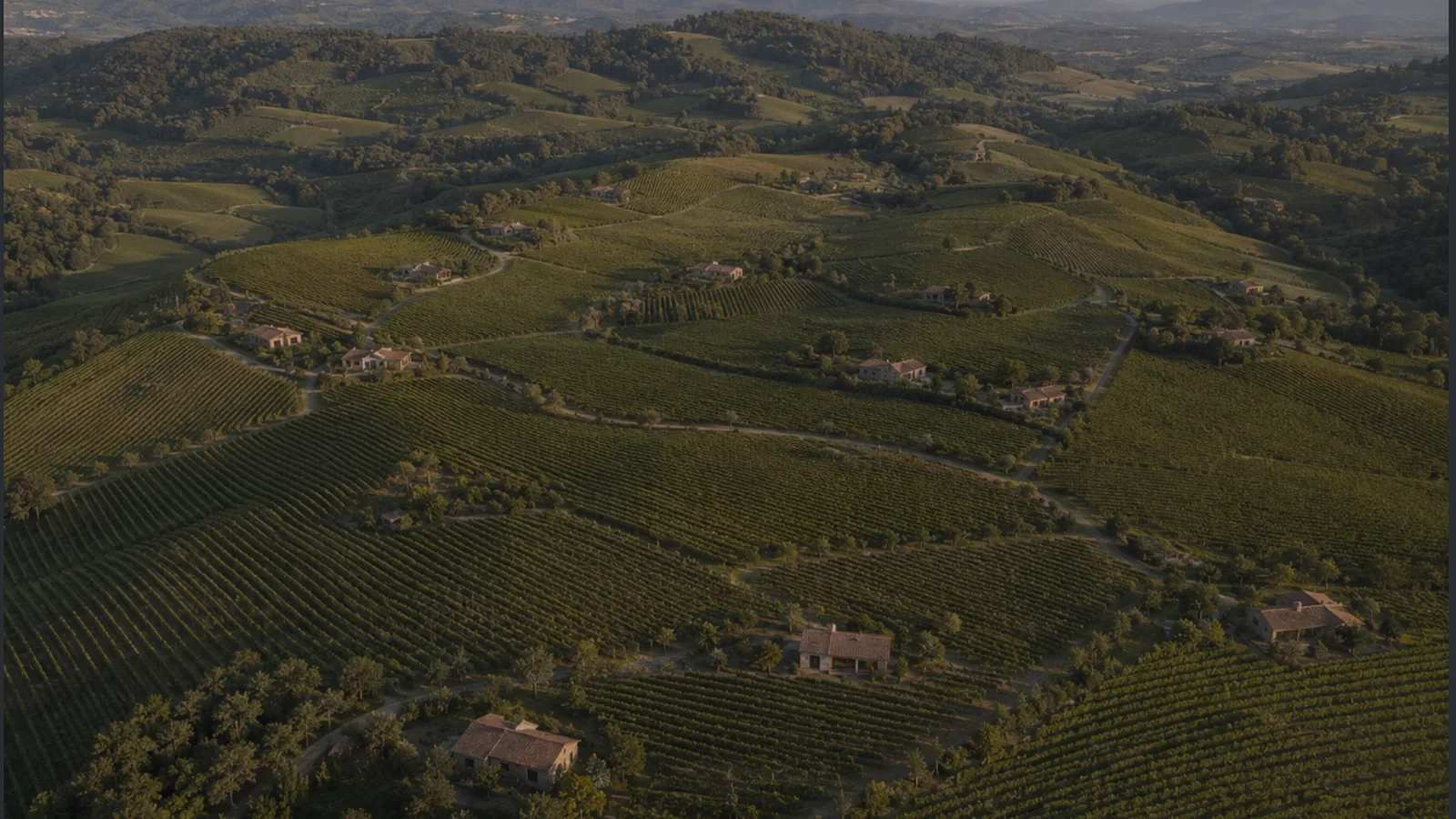
Productive rural territories increasingly face a choice between remaining economically alive and being converted into hospitality scenery. Agriculture may survive as imagery while cultivation, work, seasonality and productive purpose gradually disappear from the land.
ORIGO exists to make another outcome possible: hospitality can be introduced into an active productive landscape without replacing the agricultural identity that gives the territory its meaning. The land continues to work, and hospitality becomes one additional expression of that continuing life.
ORIGO is a Governed Hospitality System of hospitality integrated into active productive landscapes, structured around the Condition of Life of Rootedness.
ORIGO is structured around Rootedness: a meaningful relationship with land, cultivation, climate, food, material culture, work, seasonality and time. The occupant does not simply observe a rural setting. They inhabit a territory whose productive life continues around them.
02 — THE HOSPITALITY CONCEPT
ORIGO translates Rootedness into low-density hospitality integrated directly into an active productive landscape. Agriculture remains visible, operational and central to the identity of the territory. Hospitality is inserted with sufficient restraint to support the land without displacing its productive structure.
The asset is organised through distributed private pavilions rather than one dominant resort building. Architecture remains horizontal, climate-responsive and subordinate to the landscape. Food, materials, movement and atmosphere emerge from the actual productive territory rather than from a themed rural image.
Hospitality remains complete and professionally operated, but the productive enterprise retains its own purpose and rhythm. The result is an environment in which land, production, inhabitation and hospitality reinforce one another over time.
The concept can be stated in one line: productive land remains alive, and hospitality becomes another expression of its continuing life.
03 — THE ASSET AND ITS PREFERRED TERRITORIAL CONTEXT
The concept translates into a recognisable physical asset: a working productive domain inhabited through distributed private pavilions, restrained shared infrastructure and hospitality functions that remain secondary to the territorial structure of the land.
- The productive landscape remains economically active, visually legible and central to the identity of the project.
- Private pavilions are distributed individually through the territory rather than assembled into conventional hospitality clusters.
- Architecture remains horizontal, materially grounded and responsive to climate, topography and productive use.
- Food, dining, tasting or retail functions may connect hospitality with what the territory genuinely produces.
- Arrival, shared and service functions remain restrained so that no central hospitality building dominates the productive landscape.
- Where branded residences are included, they follow the same pavilion, landscape and territorial logic and do not become a separate development.
ORIGO is globally applicable wherever a genuine productive landscape can remain active and support a coherent hospitality environment. Compatible territories may include olive groves, vineyards, orchards, cork landscapes, agricultural estates, working forests, cereal lands and mixed productive rural domains.
| Pavilion typology | Role within ORIGO |
|---|---|
| T1 Pavilion | An autonomous private pavilion designed for genuine inhabitation within the productive landscape, with complete living, resting and indoor-outdoor capacity. |
| T2 Pavilion | A larger private pavilion providing greater spatial depth and living capacity while following the same distributed, low-density and territorially subordinate logic. |
These are productive territorial conditions rather than a fixed list of destinations. The agricultural system, climate, materials and architecture may change substantially from one project to another, while Rootedness and the primacy of the working landscape remain constant.
04 — WHAT MAKES THE SYSTEM DIFFERENT
Several rural hospitality categories may use agriculture, landscape or local food as part of their offer. ORIGO differs because the productive territory is not an amenity surrounding the hotel. It is the primary structure from which the hospitality asset is defined.
| Adjacent category | How ORIGO differs |
|---|---|
| Rural resort | A rural resort may use landscape as the setting for a self-contained hospitality destination. ORIGO keeps the productive territory primary and distributes hospitality through it. |
| Farm stay or agritourism | Agritourism may provide direct contact with farming activity at a small or informal scale. ORIGO establishes a complete hospitality asset while preserving the productive enterprise as a real territorial condition. |
| Wine tourism property | Wine tourism may organise the asset around tasting and visitation. ORIGO can operate in vineyards, but its logic extends to complete inhabitation, productive continuity and distributed pavilion architecture. |
| Country estate hotel | A country estate hotel often concentrates accommodation and services in one principal building. ORIGO disperses private inhabitation through the working landscape and keeps built form subordinate to the land. |
| Residential rural development | A residential development may use productive land as a value-setting backdrop. ORIGO keeps hospitality primary, residences limited where included and the productive landscape active rather than progressively privatized. |
Stated positively: ORIGO is hospitality rooted in productive land, where agriculture continues, architecture remains subordinate to the landscape, private inhabitation is distributed through the territory and the identity of the asset emerges from the land’s continuing use.
05 — HOW THE SYSTEM OPERATES
The operating logic follows the productive territory. Hospitality services are professionally managed, while the agricultural or productive enterprise retains its own operational purpose and is not absorbed into the hotel as staged entertainment.
- Service is discreet, reliable and compatible with a low-density pavilion environment.
- Hospitality movement, housekeeping, maintenance and logistics are coordinated without interrupting productive activity or landscape continuity.
- Food, dining, tasting and retail functions connect credibly to the territory where the project and productive system support them.
- Participation in agricultural or seasonal life may be available, but production is never reduced to compulsory programming or spectacle.
- Short, mid- and long-stay occupation may be accommodated within the same rooted territorial environment.
An operator is appointed by the Project Owner and remains responsible for staffing, service delivery, revenue management and operating performance. The commercial execution may vary by project, but it must remain compatible with the productive enterprise, pavilion structure, landscape primacy and established positioning of ORIGO.
06 — THE ECONOMIC LOGIC
ORIGO can support a viable asset because productive continuity, territorial scarcity, distributed low-density architecture and a credible relationship between land, food and hospitality create a position that cannot be reproduced through a conventional rural hotel formula.
| Characteristic | Economic consequence |
|---|---|
| Productive continuity | Keeping the territory active can preserve productive use, agricultural identity and a source of value that exists independently from hospitality demand. |
| Low-density pavilion architecture | Distributed private pavilions create scarcity, privacy and a relationship with land that conventional room-based rural hospitality cannot reproduce in the same way. |
| Territory-based food and hospitality | Food, tasting, retail and dining can derive credibility and complementary value from what the territory genuinely produces. |
| Landscape and architectural continuity | Restrained built form protects the qualities of the land that support differentiation, pricing defensibility and long-term asset identity. |
| Integrated residences where appropriate | A limited residential component may support the capital structure when it follows the same pavilion and territorial logic without displacing hospitality or production. |
| Identity beyond one operator | Because identity is carried by productive land, architecture and project relationships, the asset can remain distinct through changes in operator or commercial expression. |
These characteristics explain how ORIGO can create value. They are not a forecast. Rate, occupancy, capital requirement, productive income, operating cost, residence configuration and return depend on the territory, agricultural system, site, market, operator and actual project model.
07 — WHAT THE SYSTEM PROVIDES
ORIGO is a complete hospitality system structured around Rootedness and productive landscapes, developed before any individual project.
| Domain | What is already defined |
|---|---|
| Hospitality concept | The form of productive-landscape hospitality itself: how private inhabitation, service, food and shared functions are integrated without displacing the working territory. |
| Doctrine and identity | The founding doctrine of Rootedness, the primacy of productive land and the identity standards through which ORIGO is expressed. |
| Territorial logic | How productive compatibility, agriculture, climate, landscape, material culture, access and long-term land use are read together. |
| Productive landscape | The principles through which agriculture or another productive system remains active, visible and structurally central to the project. |
| Pavilion typologies | The T1 and T2 pavilion logic and the method through which accommodation and any compatible residences are distributed through the territory. |
| Architecture and interiors | The horizontal, climate-responsive and territorially subordinate architectural logic, together with the material and inhabitation principles of the pavilions. |
| Operational logic | The service model, relationship with the productive enterprise, food and hospitality functions, logistics and discreet low-density operations. |
| Economic framework | The value logic of productive continuity, territorial scarcity, pavilion inhabitation and the modelling method through which project economics are established. |
| Operator compatibility | What an operator must be capable of and how commercial and operating standards are integrated without redefining the productive territory or pavilion structure. |
| Structural governance | The embedded methods through which territory, production, typology, architecture, operations and economics remain coherent over time. |
The reader of this document is not being shown a concept to be developed. They are being shown a complete system of hospitality integrated into productive landscapes, ready to be applied to a compatible territory.