01 — THE NEED THE SYSTEM SERVES
Silence, natural darkness and uninterrupted vastness are becoming increasingly rare. Even remote landscapes can be altered by infrastructure, artificial light, mechanical noise, visible density and hospitality development that places the property before the environment.
NAARA exists to preserve the territorial conditions through which genuine Withdrawal can remain possible. It does not manufacture withdrawal through programming, treatment or emotional promise. It protects the physical and environmental conditions within which a person may withdraw on their own terms.
NAARA is a Governed Hospitality System of ultra-remote private-villa hospitality, structured around the Condition of Life of Withdrawal and protected through territory.
NAARA is structured around Withdrawal: separation from continuous exposure, density, noise, social demand and artificial stimulation through a territory where silence, darkness, vastness, distance and time remain perceptible.
02 — THE HOSPITALITY CONCEPT
NAARA translates Withdrawal into a finite constellation of ultra-low-density private-villa territories. Hospitality remains deliberately subordinate to the landscape. Architecture, infrastructure, movement and service occupy only what is necessary to make the territory inhabitable without turning it into a conventional destination product.
Five territorial conditions define every NAARA destination: Silence, Darkness, Vastness, Distance and Time. None is produced through hospitality. Each must already exist within the territory and remain perceptible after the project is introduced.
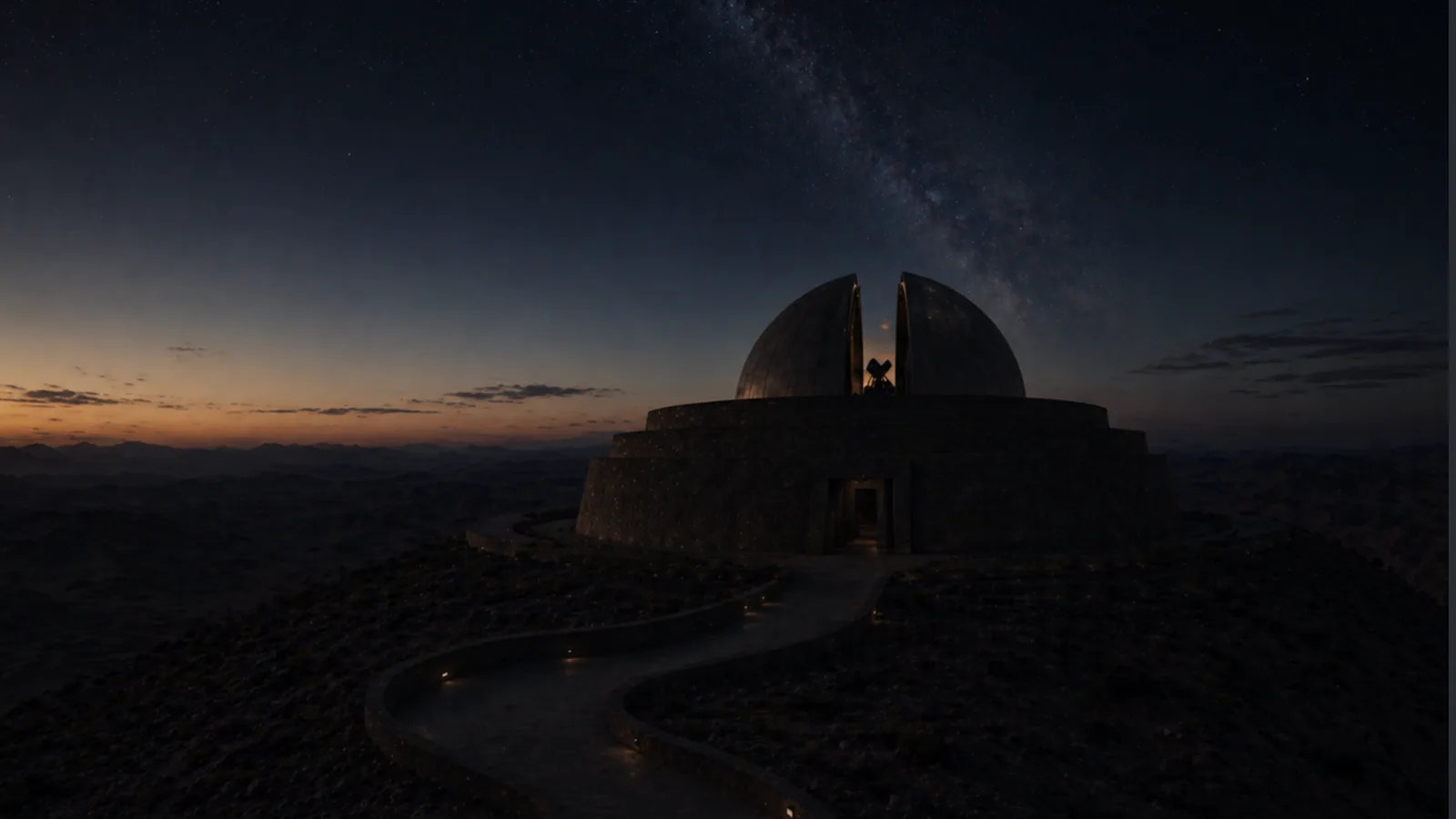
Each villa belongs to an Independent Villa Territory rather than to a visible resort cluster. The two Villa Constellations remain spatially independent within each destination. Hospitality functions are distributed so that no central guest environment interrupts Withdrawal or creates a collective daily rhythm. The Observatory is the only shared destination element and remains singular, restrained and subordinate to the territory.
The concept can be stated in one line: the territory does not perform for the occupant; it preserves the conditions through which Withdrawal becomes possible.
03 — THE ASSET AND ITS PREFERRED TERRITORIAL CONTEXT
The concept produces a recognisable physical asset: one rare environmental territory of approximately 260 hectares, occupied by two spatially independent Villa Constellations and only twenty-four villas in total.
- Two Villa Constellations preserve spatial independence within one operational territory.
- Each constellation contains twelve Independent Villa Territories.
- Each villa is associated with approximately ten hectares of private territorial space.
- Private-use hospitality functions are distributed without creating a collective centre or shared daily life.
- The Observatory is the only shared place within the destination and remains a singular, optional encounter with darkness and celestial scale.
- Architecture, service and infrastructure remain visually and operationally subordinate to Silence, Darkness, Vastness, Distance and Time.
NAARA is finite by design. Its six active territories are Utah, Montana, New Mexico, Namib, Atacama and the Empty Quarter. Mongolia, the Australian Outback and Patagonia remain strategic reserve territories capable of replacing, but never increasing, the constitutional limit of six active destinations.
| Territorial component | Role within NAARA |
|---|---|
| NAARA Territory | Approximately 260 hectares of rare environmental landscape carrying one complete destination while preserving Silence, Darkness, Vastness, Distance and Time. |
| Villa Constellation | A spatially independent group of twelve Independent Villa Territories; two remain separate within one destination. |
| Independent Villa Territory | Approximately ten hectares of private territorial space associated with one semi-buried villa and its own distributed hospitality functions. |
| Observatory | The only shared destination element: a singular, optional encounter with darkness, celestial movement and cosmic scale. |
The selected landscapes may differ radically in geology, climate, material response and architectural expression. What qualifies them is not a common visual identity, but their exceptional capacity to protect environmental silence, natural darkness, territorial vastness and the distances required for Withdrawal.
04 — WHAT MAKES THE SYSTEM DIFFERENT
Several forms of remote or nature-based hospitality provide privacy and access to exceptional landscapes. NAARA differs because the environmental condition is not the setting around the hotel. It is the primary asset that determines the scale, density, architecture, service model and finite global deployment of the system.
| Adjacent category | How NAARA differs |
|---|---|
| Remote luxury resort | A remote resort may place extensive hospitality infrastructure within a dramatic landscape. NAARA limits the hospitality footprint so that the landscape and its environmental conditions remain primary. |
| Wilderness lodge | A wilderness lodge may organise the stay around exploration or guided activity. NAARA does not require programming; the territory itself carries the condition of Withdrawal. |
| Private-villa retreat | A private-villa retreat may offer privacy within a single property. NAARA protects approximately ten hectares of territorial space per villa within a finite destination structure. |
| Wellness destination | A wellness destination may organise time around treatment, progression or programme. NAARA protects conditions without prescribing an emotional or behavioural journey. |
Stated positively: NAARA is a finite territorial hospitality system in which each villa remains autonomous, the territory remains primary, environmental conditions remain intact, service remains almost invisible and the global constellation remains permanently finite.
05 — HOW THE SYSTEM OPERATES
NAARA operates without a conventional hospitality centre, collective programme or shared daily rhythm. Service is precise, responsive and exceptionally discreet. The occupant receives complete support without the territory becoming visibly operational, socially programmed or organised around communal use.
- Arrival and movement are controlled so that distance, privacy and environmental quiet remain perceptible.
- Service is delivered privately and with minimal visual presence; staff and support activity remain outside the inhabited territorial experience wherever possible.
- There is no imposed programme, activity calendar or compulsory social rhythm.
- Hospitality functions and private-use facilities are distributed so that no central guest environment becomes necessary to daily life.
- Night operations and artificial lighting remain strictly limited to what safety, orientation and essential service require.
The Observatory is encountered by choice rather than through operational necessity. It is the only shared place in the destination. The operator is appointed by the Project Owner and remains responsible for staffing, service delivery, revenue management and operating performance. Commercial execution may vary by territory, but it must remain compatible with NAARA’s finite scale, autonomous villa territories, invisible-service posture and protection of Silence, Darkness, Vastness, Distance and Time.
06 — THE ECONOMIC LOGIC
NAARA can support an exceptional asset because it combines environmental rarity, finite global deployment, ultra-low density and a form of privacy that cannot be manufactured through conventional amenity accumulation. Its commercial strength depends on protecting what makes each territory irreplaceable rather than increasing hospitality presence within it.
| Characteristic | Economic consequence |
|---|---|
| Environmental rarity | Silence, natural darkness and uninterrupted vastness create a form of scarcity that cannot be reproduced through design or amenity expenditure. |
| Finite global constellation | The permanent limit of six active destinations and 144 villas protects rarity and prevents dilution through unlimited expansion. |
| Ultra-low density | Approximately ten hectares per villa create privacy, distance and territorial integrity that conventional luxury density cannot provide. |
| Territory as primary asset | Value is tied to the long-term protection of the landscape and its environmental conditions rather than to continual addition of built hospitality functions. |
| Invisible operational model | Distributed private-use infrastructure and discreet service focus investment and operations on what the system genuinely requires. |
| Long-term coherence | Consistent protection of the finite structure and environmental conditions supports durable identity, pricing defensibility and asset distinction. |
These characteristics explain how NAARA can create value. They are not a forecast. Rate, occupancy, capital requirement, operating cost, territorial acquisition, infrastructure and return are established for each destination through a project-specific financial model.
07 — WHAT THE SYSTEM PROVIDES
NAARA is a complete finite territorial hospitality system structured around Withdrawal and the protection of rare environmental conditions, developed before any individual territory is activated.
| Domain | What is already defined |
|---|---|
| Hospitality concept | The form of finite territorial private-villa hospitality through which Withdrawal is protected without being programmed, performed or organised around collective use. |
| Doctrine and identity | The founding doctrine of Withdrawal, the hierarchy of environmental conditions and the identity standards through which NAARA is expressed. |
| Global constellation | The finite six-destination structure, primary territories, strategic reserve territories and permanent global villa limit. |
| Territorial logic | The criteria through which Silence, Darkness, Vastness, Distance and Time are identified, protected and tested within a candidate territory, including the singular role of the Observatory as the only shared destination element. |
| Villa and constellation structure | The two-constellation organisation, Independent Villa Territories, private territorial scale and autonomy of each villa within the landscape. |
| Architecture and interiors | The semi-buried mineral architecture, material restraint, private-villa components and principles through which built form remains subordinate to territory. |
| Private-use and support functions | The distributed private-use facilities and operational infrastructure through which complete support is provided without creating a central guest hub or collective daily life. |
| Operational logic | The invisible-service posture, controlled arrival, restricted night operations and absence of compulsory programming. |
| Economic framework | The economic reasoning of finite rarity and the modelling method through which each territory’s own project economics are established. |
| Implementation and continuity | The methods for applying, validating and preserving NAARA’s coherence from territory selection through opening and long-term operation. |
The reader of this document is not being shown a resort concept to be developed. They are being shown a complete finite hospitality system, ready to be applied only within a territory capable of protecting Withdrawal.